Showing posts with label spices. Show all posts

Monday, May 23, 2016

Mole


Mole is a very complex sauce utilizing many different ingredients.  It is considered the Mexican national dish, which makes sense considering it has almost every single Mexican ingredient in, I mean take a look:


Growing up, it was very common to have mole from a store-bought mole paste which was prepared by adding more ingredients.  This makes sense considering how time consuming the process can be, it is common to see various mole pastes for sale in markets.  I wanted to make my own mole, preparing each individual ingredient, and balancing the taste out as necessary. I used as my source Diana Kennedy's The Art of Mexican Cooking.  In there she has a recipe for Oaxacan black mole.  I used some of the proportions as a guide but used some different ingredients I've seen also used in mole poblano. 


The process is fairly straightforward, it's just the amount that needs to be done. Each ingredient needs to be toasted on a comal.  For spices and the sesame seeds I used a pan, just to make them easier to handle.  Traditionally a metate is used to grind all the ingredients into a paste, but I used a blender, adding just enough liquid at a time to get it going without make it too wet, it should still be a paste.  Some more detailed steps are included in the recipe below.


Mole


10 chiles guajillo
10 chiles ancho
10 chiles pasilla
5 chiles cascabel
4 tomatillos, peeled
4 cloves garlic
1 platano maduro
1/2 cup reserved chile seeds
1/2 cup almonds
1/2 cup pumpkin seeds
1/2 cup sesame seeds
1/2 cup raisins
1/2 of a stick of canela
3 allspice berries
4 cloves
6 peppercorns
1 tsp cumin seeds
2 tsp marjoram
2 tsp Mexican oregano
1 tsp thyme
2 tortillas
1 bolillo
1/2 cup lard
salt
1 tablet Mexican chocolate
1-2 tsp sugar
5-6 cups chicken broth


Toasting the ingredients
- Toast all ingredients on a comal until golden brown, except for chocolate.  For small seeds, spices, herbs a sauté pan might work best and heat through until fragrant.
- For chiles specifically: toast ancho and pasilla for 2-3 minutes on each side. Toast guajillo and cascabel for 4-5 minutes to get them very dark/black. Place in a bowl and cover with boiled water for 25 minutes.
- Platano maduro can be griddled skin on, the heat will soften it.
- For the bolillo: heat the lard until hot, fry the bread well on all sides.


Blending the ingredients
- This might need to be done in batches depending on the size of the blender.
- Start with chiles and nuts/seeds as these will get the thickest.  Add just enough water at a time to get the blender going, you may need to push ingredients down.
- Blend the remaining ingredients, except for the chocolate, chicken, and lard.
- At this point, it should be a slightly thinner paste


Finishing the sauce
- Heat the lard in a large pot or dutch oven until very hot.
- In one motion, pour all of the mole over the lard, the idea is to fry the sauce and cook it really well. Stir occasionally for 5 minutes.
- After this point, add the chocolate and stir well so it can break up and get incorporated.
- Add chicken broth and allow this to simmer for an hour, stir frequently to avoid sticking.
- Towards the end, use a stick blender to smooth out the sauce a bit more.

Eating the sauce
Boiled shredded chicken mixed into the sauce what I grew up with and still my go to.  I also really love just the mole over red or white rice, I really love the texture difference.  The more traditional would be turkey meat, but beef and pork also work really well.  It is a fairly versatile sauce given how complex it is.  There is also nothing wrong with just drinking it out of a bowl, right?


Monday, February 1, 2016

new salsa

The salsa I made yesterday was a hit!  I really love how it came out, it was great with chips and made the perfect vehicle for a guisado de Puerco.  What I did to make this is take the idea  just a regular salsa verde, but adding habaneros for more heat and mulatos for a more earthy complex flavor.   I will be taking pictures and making an update post, but wanted to make sure I jot this down.


1 chile jalapeño
1 chile serrano
1 chile habanero
1 chile guajillo
2 chile mulato
10-12 tomatillos
1 white onion
4 cloves garlic


1 handful cilantro
3 bay leaves
2 big pinches of Mexican oregano
1 tablespoon ground cumin
juice of 1 lime
salt to taste


- Turn the oven up to 500 and place the jalapeño, serrano, habanero, tomatillos, onion and garlic into a baking dish.  You will want to cook this over several minutes in the oven, turning over to get some char on various sides of the vegetables.
- Split the guajillo and mulato in half and remove seeds, placing on top of the already roasting vegetables.  The idea is to get some color on these as well, but they do not take as long, After they get toasted and darken, remove the baking dish and place the dried chiles in a bowl with boiling water, they will steep for at least 15 minutes.
- Once the remaining vegetables have a decent amount of charred parts on many sides, add them to a blender with the remaining ingredients. Once the dried chiles have rehydrated, they can be added to the blender.  Blend everything together, using the steeping liquid to loosen if necessary.  Add additional salt and spices to your preferred taste.

Tuesday, December 8, 2015

Chile-rubbed sous-vide brisket

This past weekend, we hosted a friendsgiving potluck.  I wanted to contribute a roast, but didn't want to just do a turkey or ham.  I settled on a brisket, something I have made with mixed results in the past.  A while ago I got an immersion circulator and have heard many success stories about cooking the brisket with this method.  


I'm a big fan of an oven braised brisket, I somewhat like that the slices hold somewhat firmly together, but the meat itself is tender.  I was afraid that cooking sous-vide would make the brisket maybe TOO tender (if there is even such a thing).  I also heard that the juices that come out of the bag are not very flavorful and usually just tossed.  This was something that made me almost not cook it this way, I didn't want to miss out on pan juices.  However, in the spirit of branching out and trying something different I went for it and decided to try my luck on a sauce.


I trimmed off a good deal of fat from the brisket.  Some said I maybe took too much off, but I figured given the sous-vide, the meat will still properly cook and be tender.  I then toasted my flavors: pink peppercorns, cumin seed, coriander seed, Mexican oregano, bay leaves, ancho, pasilla, garlic.  I put all of these ingredients into a spice grinder (with the garlic) and had a very loose paste to rub all over the brisket.  I loved the color of the spice rub on the brisket, it was a deep dark red color.  After this, I did a pre sear on both sides.  The spices burned a little, so I wonder if the rub should've gone on after searing, something to experiment with.


After vacuum sealing, it was time for the brisket to go for a bath.  I cooked it at 134F for about 45 hours.  Recommendations varied from 130-140 for 48 hours, so I went somewhere in between on the temperature.  The 45 hours was a result of starting it a little late, but I didn't think it would have much of an impact at that point.


The brisket came out as one solid piece. I've heard that it can sometimes fall apart when it comes out of the bag, I was able to place it in a super hot oven for a few minutes just to get some sort of color on the outside without cooking it any further on the inside.  I was able to cute nice slices out of the brisket, and the texture was wonderfully tender.  The spice rub colored the outside nicely as well and the earthy toasty flavors really came through.  I was also lucky enough to get a flavorful and meaty bag juices.  I reduced them in a pan and added pads of butter while off the heat to finish.  This was spooned over the slices.  I am happy to say that all 9 pounds of brisket were happily devoured by our guests.  This is definitely going to be something I'll be making more often, it might even be a new holiday tradition.

Monday, October 26, 2015

Caldo Tlalpeño


Finally got some serious cleaning around the house,  got some things reorganized.  Isn't my counter pretty?  I was excited to get my cutting board area set up how I like :).  Drew came home from a trip yesterday so I wanted something comforting, something with flavors he is used to me using.  He loves soup so I went with caldo tlalpeño, something I have gone to in the past, I really enjoy making it, and eating it!


Caldo tlalpeño reminds me very much of something like pozole or menudo: a broth with a puree of chiles and spices stirred in for flavor and heat.  Typically it is done with chipotles and can be put together very easily with canned chipotles in adobo.  I had roasted guajillo, ancho, chipotles, and garlic on the comal earlier in the week for something else, so I decided to use this mixture. 

 
I added the chiles to a blender jar and topped with boiling water. I let this sit for about 20 minutes, then added cumin seeds, bay leaves, and Mexican oregano which I also toasted on the comal.  The result was a deep dark red puree.

 
I seared chicken legs in a skillet, I wanted to get the cooking process started on these and got some additional flavor by cooking in a little bit of bacon fat. I added garlic towards the flavor to give it more of a garlic flavor. I removed the skin from the legs and let them continue to render out.
 
 
After that the legs went for a swim in chicken broth with my paste mixed in.  I let this simmer on low for about 40 minutes until the meat was falling off the bone.


While the chicken was cooking, I prepared my vegetables that would go into the soup.  Carrots, potatoes, garbanzo beans will go right into the cooking soup. Cabbage and cilantro will go on top when it is all done.


I cubed 1 carrot and 3 potatoes and added to the cooking soup during the last 15 minutes.  I also drained one large cans of garbanzos and tossed it in while it finished simmering.

 
To finish, I served in bowls and topped with diced onion, shredded cabbage, chunks of avocado, and lime juice.  I added cilantro and tortilla chips broken up into the soup as well.


For the second helping, I added the crispy chicken skin that I left in the skillet as well as a chile pasado relleno.  A relative just came back and brought back chile pasado which is a roasted then dried poblano, typical of where my family is from.  My mom surprised me with rellenos made from these and thought it would be perfect with the soup.
 
Recipe after the jump!

Wednesday, March 12, 2014

coconut milk braised pork

I love pork and I love coconut so obviously both together would be amazing.  I had a spare can of coconut milk in my cabinet and wanted to use it.  I initially thought of other recipes I've done which basically involve braising pork shoulder in liquid. Most recipes I found seem to incorporate ginger and lemongrass. That sounded good so I went with that. I also wanted it to be fairly spiced with cumin and coriander.


I began by first adding ginger, lemongrass, chile serrano, and garlic cloves to a molcajete.


I smashed all the ingredients together until it formed somewhat of a paste.


These are pork shoulder steaks.  These seemed easier to manage versus a full shoulder for a weekday meal.


Adding salt to the pork steaks before browning in the dutch oven.


After flipping the second steak.  I'm getting better at not checking it and just letting it get nice and brown.


I removed the pork steaks after cooking at set to the side to prepare the rest of the stew ingredients.


I added coriander and cumin seeds and heated through in the remaining oil and pork fat to extract the flavor.


I added my garlic/ginger/lemongrass/chile paste and sliced onion to the porky spices in the pot.


I added the can of coconut milk along with a canful of water and scraped the pork pieces stuck to the pan.
I placed the pork steaks in the coconut mixture then let it boil slightly before covering and braising on low.


The pork was falling apart after a few hours. It was tender and and the coconut came through.


Not wanting to waste the delicious porky coconut goodness, I added kale to the leftover broth.


I broke the pork up into pieces and placed over rice.  I then ladled kale and coconut broth over.  The dish is rich as expected so to counteract that a little bit I squeezed limed juice before serving.  The spices really came through well and I especially the cumin coming through in the coconut milk.

Thursday, January 23, 2014

taco night tacos

I was recently talking to someone about taco night tacos.  These are better known as the American style taco which consist of a hard shell and ground beef cooked with taco seasoning.  I wanted to make my own version of it.  I began by making a seasoning mix.


The mix consisted of 3 tablespoons ground chile ancho, 2 tablespoons oregano, 2 tablespoons cumin, 1 tablespoon smoke paprika, 1 tablespoon salt, 1 tablespoon pepper, and 1 teaspoon of cornstarch.  I saw a couple of recipes including cornstarch so I decided to give it a shot.  I think the idea is that it thickens whatever juices come from the meat when being cooked.

For my filling, I did a half pound each of ground beef and ground pork.  I cooked this in a pan with onions and garlic before adding the spice mix.


Another one of the key components to this dish is the crispy tortillas.  I did not want to simply buy a box of shells so I went with some regular corn tortillas that I heated over an open flame then shallow fried in oil. I only did this for about 30 seconds on each side making sure they got a bit crisp but not hard.


I while they were still warm I folded the tortillas over the grills in the oven rack to set.  I placed a large dish underneath to catch any additional oil. 


Once this was done, I had taco shells!  It was time to put together the tacos.  For my filling I had the taco meat, sliced avocado, some greens tossed in lime juice, and a sauce I made by combining the fried tomatillo salsa with crema mexicana.


I finished the tacos by topping with some cotija cheese.  I very much enjoyed this version of a taco night taco.  The tortillas was crisp but still had a little give and didn't shatter and all the fillings worked well together.  The meat itself had a decent amount of seasoning and made a bit of a sauce.  The tomatillo salsa crema had a fair amount of heat and the creaminess went well from the crunch of the tortilla. 


Wednesday, May 18, 2011

picadillo


Picadillo to me is one of those classic dishes that comes together easily and gets better the longer it sits.  There are many variations but typically it is a combination of ground (or chopped) beef with diced veggies.  Sometimes a few raisins and pieces of hard-boiled egg are thrown in as well.


For my picadillo I decided to combine ground beef with carrots, potatoes and green beans.  I chose not to go with raisins but I will be adding an egg later on.  To begin I sauteed onion, garlic and chile serrano until the onion became translucent. 


I then added the ground beef.  After the beef browned, I added the vegetables.  I cut them all relatively small so they could cook more quickly.  I threw the potatoes in a bit early but soon after I added the carrots and green beans.  I lowered the flame and let the beef sit for a bit while i combined a spice mix.


 I wanted to add some additional flavor to the picadillo, so in a small bowl I combined ancho chile, cumin, mexican oregano, salt and pepper.  These spices added warmth and smokiness to the beef.  I allowed everything to cook together for a few more minutes.


I served the picadillo in a bowl with sliced hard boiled egg.  Normally the egg is mixed in with the beef but the egg on top adds a nice touch.  I served with warm tortillas and dinner was ready.  The leftovers the next day were just as good if not better, so it is best to make a large batch!

Tuesday, January 18, 2011

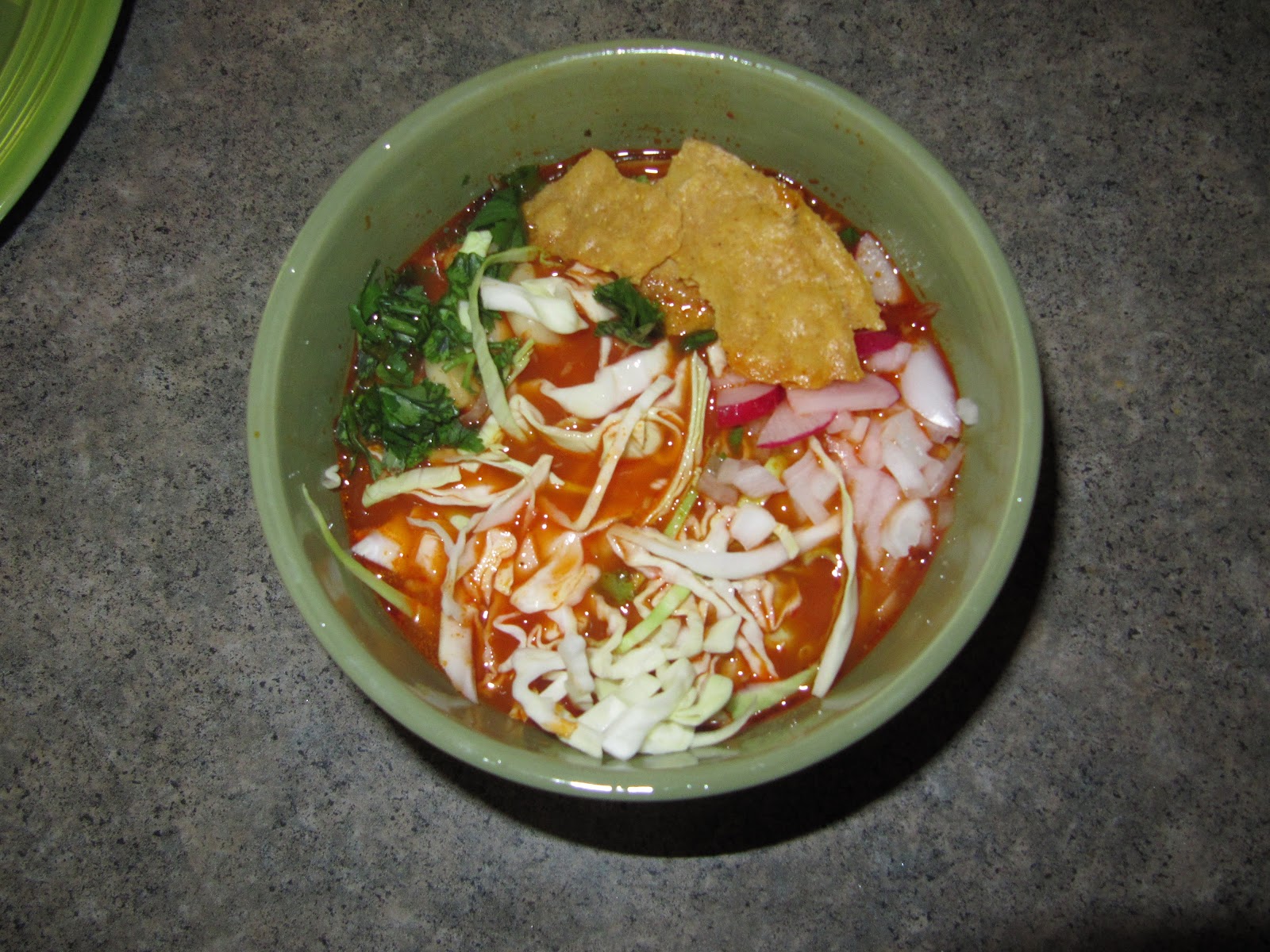
Pozole Rojo

For this update I would like to return to a dish that holds a special place in my heart, pozole! To me this is a dish that represents home, family, comfort and just how good food can be. This is also one of the first things I learned how to make from my mom.

The word pozole in Mexican Spanish is refers to hominy. Hominy in the US is most commonly found ground in grits. In Mexico, pozole is kept whole and serves as the basis for the dish of the same name. Pozole the dish is a soup which consists of hominy and pork and can vary in color from red to green to clear depending on the whether or not the broth is flavored with chiles and spices. The version I grew up with was red which gets its color from guajillo chiles.


One of the most interesting aspects of pozole is the garnishes. Alongside the soup itself you have an option of adding as much shredded cabbage, sliced radishes, diced onion, cilantro, Mexican oregano and broken up tostada pieces as you like. The fresh ingredients contrast with the hot soup and add texture. The closest comparison I can think of is Vietnamese pho. Both soups are actually eaten in a similar context, usually being the breakfast/brunch meal shared with loved ones.

The broth for pozole is primarily a pork broth but you get a certain also get a certain corn flavor from the hominy itself. To begin I used a pork shoulder with as much fat trimmed off as possible. This fat can be used to crisp up in the oven as an additional garnish if you so choose. I placed the pork shoulder in a 400 degree oven and roasted for about a half hour before placing in a stock pot and covering with water. I added a half an onion and a few cloves of garlic and simmered on low for about 3 hours until the pork meat is tender. I removed the pork meat to cool for cutting into chunks and got to work on the hominy.


For the pozole part of the dish I decided to use dried hominy that I picked up at the local Mexican grocery store. The suggested preparation for dried hominy is to let it sit overnight in cold water then to boil in the broth slowly for about 2 hours. I usually use canned hominy but I found that boiling the dried hominy directly in the broth gives a thicker broth with more corn flavor. Either option gives great results.


While the hominy was boiling I took off the stems and shook out the seeds from 10 guajillo chiles. I placed the chiles in a bowl and I used some of the hot pork broth to cover them to soften for 15 minutes or so.


I moved the chiles to a blender and added a couple of cloves of garlic, Mexican oregano, cumin, bay leaves, salt and pepper. I added a bit of the broth and blended for a few minutes until all the ingredients are fully ground. The result is a deep red sauce that can be added directly to the soup.


I added the guajillo mixture along with the chunks of pork back into the pot with the hominy during the last half hour of cooking so that all the flavors could come together. While the soup finished cooking I shredded cabbage, thinly sliced radishes, diced onions and chopped cilantro to prepare my dish of garnishes for people to add what they like. I also had tostadas on hand to break into the soup prior to eating.


This soup to me is addictive. The rich pork and corn flavor really came through and the soup thickened a bit as the hominy boiled away. The chiles provided a deep red color, spice and a certain earthy depth of flavor that really makes this version stand out. I usually like to garnish with a bit of everything, cabbage being my personal favorite.


This dish, like many traditional homestyle Mexican dishes are really made by using all the senses and sort of winging it. It is really difficult to pinpoint exact measurements, but I have made an attempt at a recipe. If you end up trying this, I’d love to hear your thoughts!


Recipe after the jump...